
Open Science
We provide open-data hazard values for main chemicals used in the industry. Models are based on state-of-the art scientific knowledge while assumptions and limitations are clearly documented.
Open access to up-to-date scientific data for environmental assessment of chemicals — without complexity.
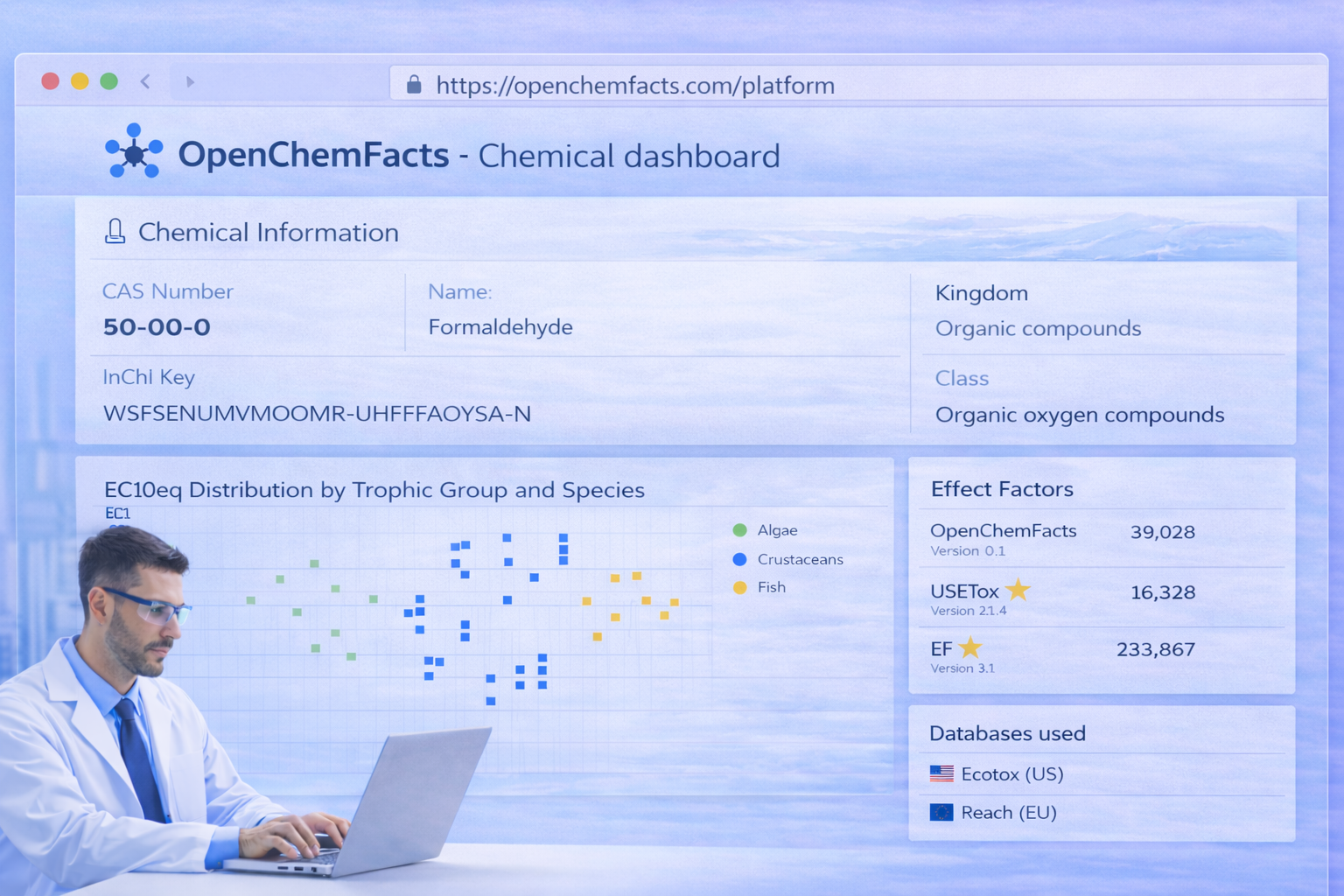
We support public and private stakeholders by providing expertise and tools for specific environmental chemistry use cases.
Illustration of projects :
– In-silico prediction of the biodegradability of sunscreen formulations for a French laboratory
- Definition and assessment of chemical emission scenarios for the textile industry, conducted in a Life Cycle Assessment (LCA) context for the French administration
- In-silico ecotoxicity assessment of detergent formulations for two French brands

Our mission is to bridge scientific knowledge and real-world decision making by providing reliable, transparent, and actionable chemical information for industry, researchers, public authorities, and civil society.
We build our solutions around open, documented, and reusable chemical datasets so that any stakeholder can access, contribute to, and collaborate on a shared knowledge base.
Methods, assumptions, data sources and limitations are documented
The project is fully self-funded
OpenChemFacts is currently maintained by its founder and is open to welcoming new contributors.
.png?width=612&height=612&name=Alban%20Fournier%20(profil%20couleur).png)
Project founder
(Industry + LCA expertise / based in Annecy)

We aggregate validated toxicity data and apply harmonised methods inspired by regulatory risk assessment.
No black box, everything is documented.
Yes, you can integrate your own data as long as methods and endpoints are clearly documented. This helps refine hazard values and reduce uncertainty.
Your data remain under your control.
We don’t replace regulatory assessments, but we help screen and compare the environmental hazards of ingredients, formulations and products.
Early-stage screening of chemicals and products for environmental hazard and safer alternatives.
Scientists and companies can help improve OpenChemFacts by sharing relevant data or providing feedback on the method and platform.
A dedicated tool is available to compile contributions for active users.